There's a tell I've started watching for when a company walks me through their AI initiative. It's not in the deck. It shows up about ten minutes in, when I ask a simple question: are you actually ready to run this?
The pause that follows tells me everything.
Teams that have thought it through answer fast and specific. They know the state of their data. They can name the workflows they're planning to change. They've had the alignment conversation with the people whose jobs are going to look different. Teams that haven't answered the readiness question start talking about vendors. Or timelines. Or executive sponsorship. Everything except the two or three things that will actually determine whether any of it works.
This isn't a knock on ambition. The initiatives I see aren't underfunded or underled. IBM's Watson Health had more than four billion dollars behind it, serious institutional backing, and a real mandate to transform clinical decision-making. What it didn't have was structured, usable data at the point of care, clinical workflows that had been mapped to where AI could actually intervene, and teams aligned on what "working" looked like before the contracts were signed. By the time those gaps surfaced, the clock had been running for years. That's an extreme version of something I watch happen at a much smaller scale in deals we're evaluating and companies we work with. The capability is there. The readiness wasn't checked.
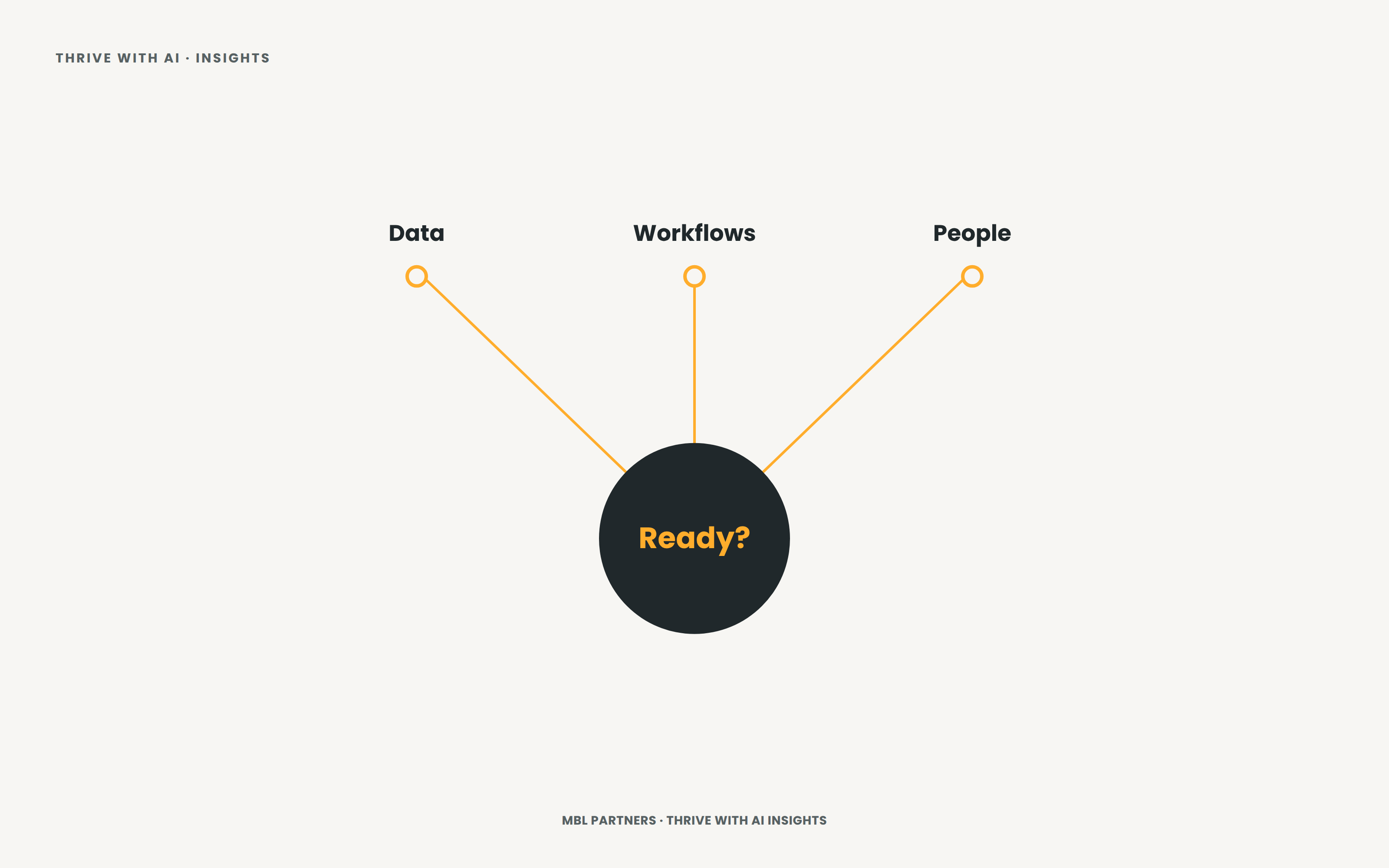
Readiness comes down to three things. The data has to be in a state where it can actually be used. The workflows you're planning to change have to be mapped, not assumed. And the people whose work changes have to be aligned on what they're building toward, not just told that change is coming. None of these are complicated to assess. All of them get skipped when "are we doing AI?" gets treated as the same question as "are we ready for AI?"
I watch the pause because that's where the real answer lives. When I ask a leadership team to describe the current state of the data that will feed the initiative, teams that are ready can answer. They might flag gaps, but they know what the gaps are. Teams that aren't ready start explaining the strategy again. They know the destination. They haven't looked hard at the starting point.
That gap has a real price. A few hours of honest internal conversation before a commitment is made costs almost nothing. The same conversation held six months into an initiative that has stalled costs significantly more: in capital, in credibility, and in the organizational will to try again.
You don't need a formal readiness audit to do this. You need the right three people in a room: whoever knows the actual state of your data, whoever owns the workflows you plan to change, and whoever leads the teams being asked to adopt something new. Give it an hour. Either you surface problems you can solve before they're expensive, or you confirm you're further along than you thought. Both outcomes are worth the time.
We built a diagnostic to structure that conversation. It runs in Cowork, takes about ten minutes, and gives you a readiness snapshot: where you're strong, where the gaps are, and what needs to close before you move. The question it's asking you is the same one I ask in every room. Worth knowing your answer before the initiative is already in motion.
Download the skill: AI Readiness Diagnostic.
Install in Cowork: download the file, drag it into your Cowork window.
MBL Partners · mblpartners.com · [email protected]