Every company I work with is sitting on the answer to its own most expensive question and cannot retrieve it. The decision was made in a meeting eight months ago. The reasoning lived in one person's head, the context in a thread nobody can locate, the follow-up in a document three reorganizations deep. The knowledge existed. The system to hold it did not.
I have watched two companies of identical size and talent diverge entirely on this one variable. One treated knowledge as something individuals carried. The other treated it as something the system held. Three years later they are not in the same weight class. The divergence did not come from a technology advantage or a talent gap. It came from one organization's willingness to commit to an architecture, the way knowledge actually moves through the organization, while the other kept deferring.
A company brain is not a tool you buy. It is a commitment you make to how knowledge moves. Recorded meetings, transcripts, structured follow-ups, a shared library of work: these are not four features. They are one system, and the value is entirely in the connections between the parts. The recording is worthless if it is not transcribed, the transcript is worthless if it is not searchable, and the search is worthless if what it surfaces does not flow back into the work.
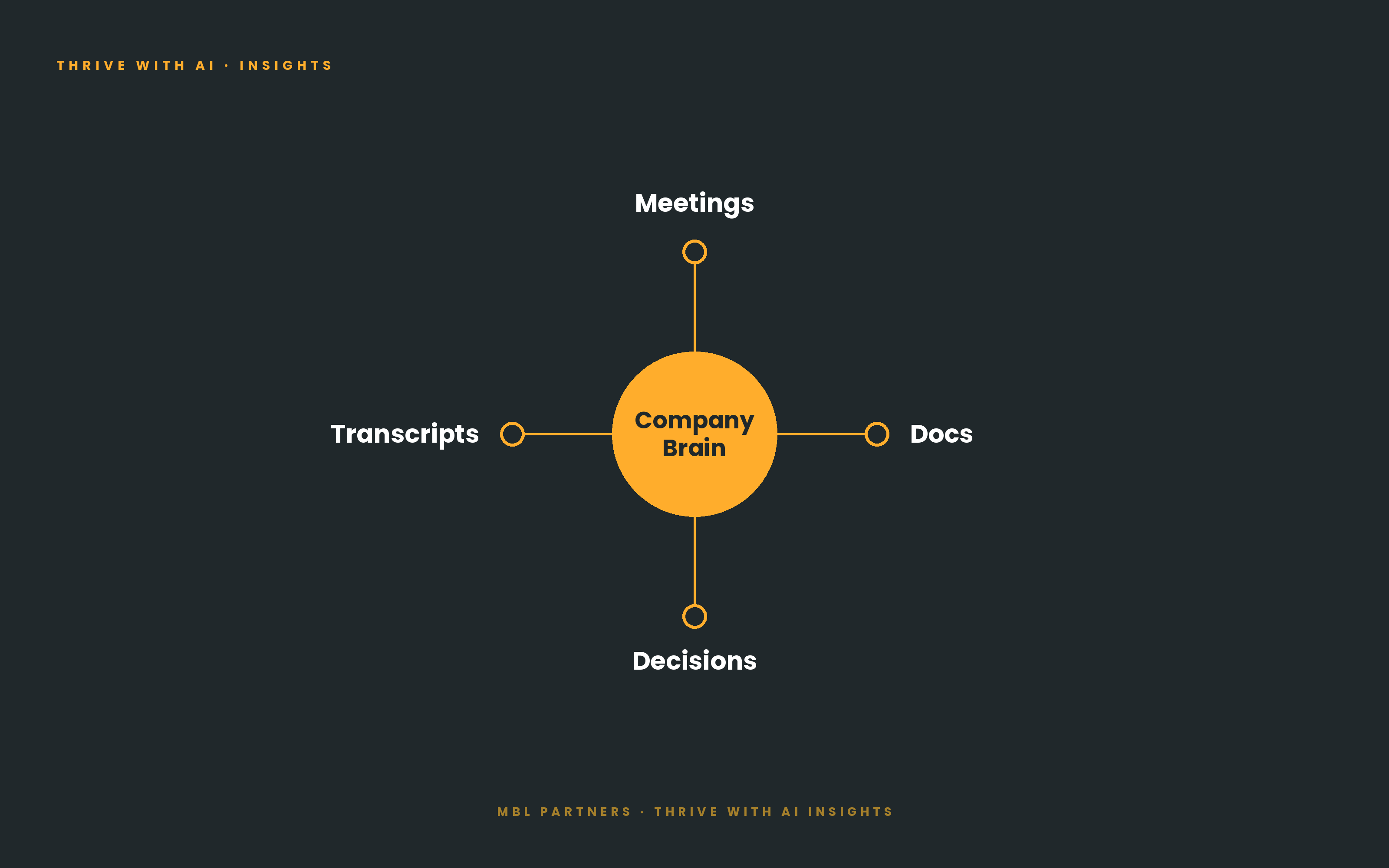
The orchestration layer, the part that connects the pieces so they behave as one, is where the actual value lives. The pieces get bought. The layer that connects them gets skipped. That is the pattern I see repeated, and it is the easiest advantage most companies leave on the table. Connect the pieces, and the context you already created starts compounding instead of disappearing.
Once that layer exists, something else becomes possible: you can finally measure the thing that has always been invisible. Not how many hours your people sat in meetings, but what those hours produced. Production over time. Value created over production. Shipping speed over headcount. The metrics that have always mattered and have never been legible suddenly are, because the record exists to surface them.
You do not need a transformation budget to begin. You need to start keeping your most expensive conversations. Start with the meetings nobody captures, the ones where the real decisions get made and the reasoning never gets written down. Record them. Transcribe them. Make the transcripts searchable and the follow-ups findable. That single discipline, held for a quarter, will show you how much your organization already knows, and how much of it you can finally put to work.
Then watch what your best people do with a system that remembers. The hours they used to spend reconstructing context, tracking down what was decided and why, go back into judgment, into the calls only they can make. The system handles what happened. Your people focus on what is next.
The org chart tells you who reports to whom. The company brain tells you what your organization actually knows, and whether it is getting smarter or just older.
Build one, and you stop announcing your edge because you no longer need to. You win the bids you never knew were close. You onboard faster, retain better, and execute without the ramp. Eighteen months from now you are the one who pulled ahead, and the reason is simple: you kept what you learned while everyone else kept losing it.
Become the company that remembers.
A Final Note
MBL helps leaders and organizations build systems like this, and it starts with finding where your knowledge is leaking today. If you want to go further, you can take our free AI Assessment: it scores your team's readiness across six dimensions and lands in your inbox within one business day. Or reach out directly at [email protected] to talk through what a company brain could look like for your organization.
MBL Partners · mblpartners.com · [email protected]